

using macd and bollinger bands for binary options hourly trade
Here's the matter:
Many new traders think they need more indicators to be a consistently assisting trader.
But the truth is…
It doesn't work that way.
Imagine this:
The price is above the twenty menstruation MA but RSI is showing the market is overbought.
At the aforementioned time, the ADX indicator is at 25 which shows a non-trending market.
Then, which do you follow?
Now yous're stuck, right?
Well, the proficient news is…
Bollinger Bands tin can help y'all overcome this outcome — and much more.
That'due south why I've created this Bollinger Bands trading strategy guide to evidence yous how useful this indicator is and what it can do for your trading.
You'll learn:
- What is the Bollinger Band indicator and how does information technology work
- Bollinger Bands trading strategy: How to buy low and sell high
- How to utilize Bollinger Bands and "predict" when the market is ready to breakout…
- How to trade with the trend using Bollinger Bands
- The Bollinger Bands and RSI Combo (a little-known technique)
- The Rubber Ring effect: How to use Bollinger Bands and "predict" market reversal
Or if yous prefer, you tin scout this grooming video beneath…
Bollinger Bands explained: What is it and how does information technology piece of work?
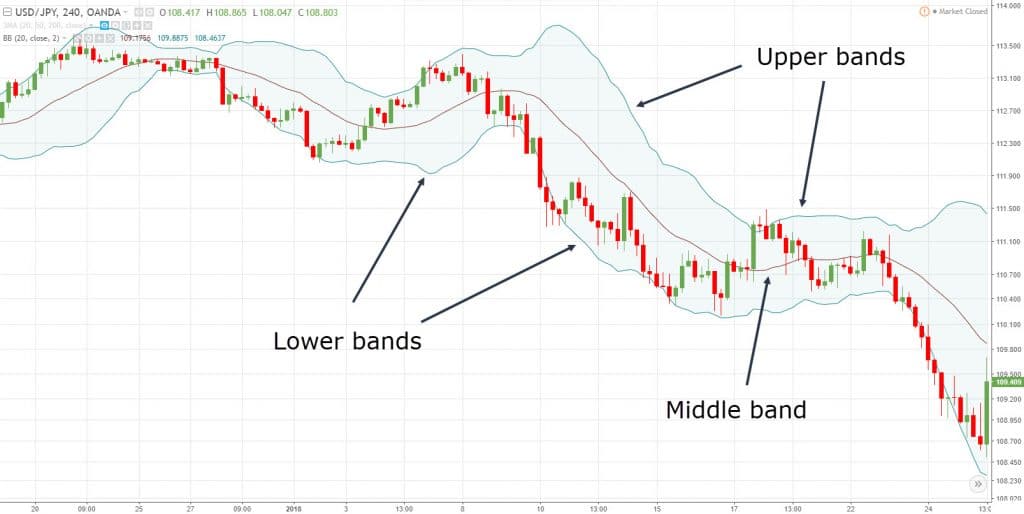
Bollinger Bands is a trading indicator (which consist of 3 lines) created by John Bollinger.
It tin can help you:
- Identify potential overbought/oversold areas
- Identify the volatility of the markets
Now you're probably wondering:
"What exercise the 3 lines mean?"
Upper ring – Centre band plus ii standard deviation
Lower band – Eye band minus 2 standard difference
Middle band – 20-menstruum Moving Average
Note: I've used the default settings for Bollinger Bands which is twenty-period moving average and two standard deviations for the upper and lower bands.
So, what is standard deviation?
Well, it basically measures how far you're away from the average.
If you lot want to learn more, go study this lesson on standard deviation.
So in other words…
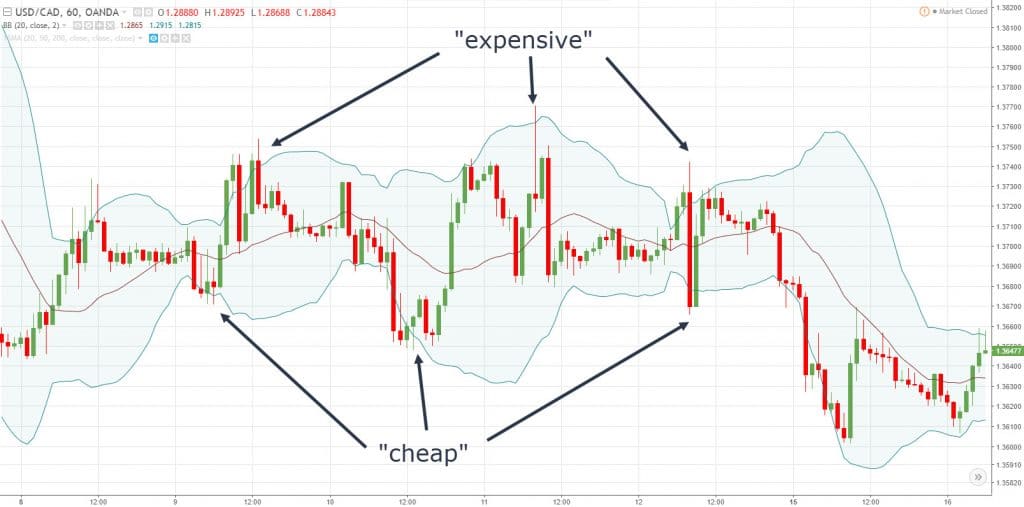
If the price is almost the upper Bollinger Band, it'south considered "expensive" because it is two standard deviation higher up the average (the xx-period moving boilerplate).
And if the is price near the lower Bollinger Band, it'southward considered "inexpensive" because information technology'south 2 standard deviation below the boilerplate.
Here'due south an example:
Do not brand this MISTAKE when trading Bollinger Bands
At present…
But because the price seems "inexpensive" or "expensive" doesn't hateful you enter a trade immediately.
Because in trending markets, the market can remain "cheap" or "expensive" for a long period of fourth dimension.
Hither's an example: EUR/USD remained "expensive" for many months…
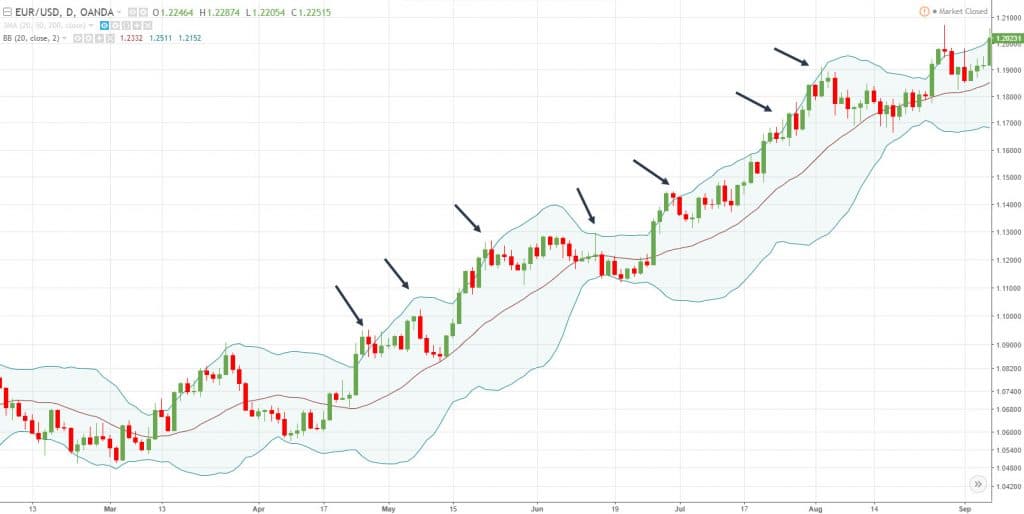
As you lot can see, it's a painful thing to do if you blindly shorted when the price is at the upper bands.
And then what should you do?
Read on…
Bollinger Bands trading strategy: How to purchase low and sell high
You've probably heard this a gazillion times.
If you want to make coin in the markets, just buy depression and sell high.
Just the question is… HOW?
Well, y'all tin do and then with Bollinger Bands (duh).
Recall:
The outer Bollinger Bands are 2 standard deviations away from the mean.
This means if the price is in the lower band, information technology'south considered "inexpensive". And if it'due south in the upper band, information technology's considered "expensive".
But before you think…
"Groovy! I'll merely go long when the price reaches the lower band."
Not and so fast my young Padawan.
If you want to have a higher probability of success, then yous'll need a few confluence factors coming together before y'all merchandise the bands.
For example:
- Look to long the lower band in an uptrend (and vice versa)
- Reversal candlestick patterns that evidence signs of reversal
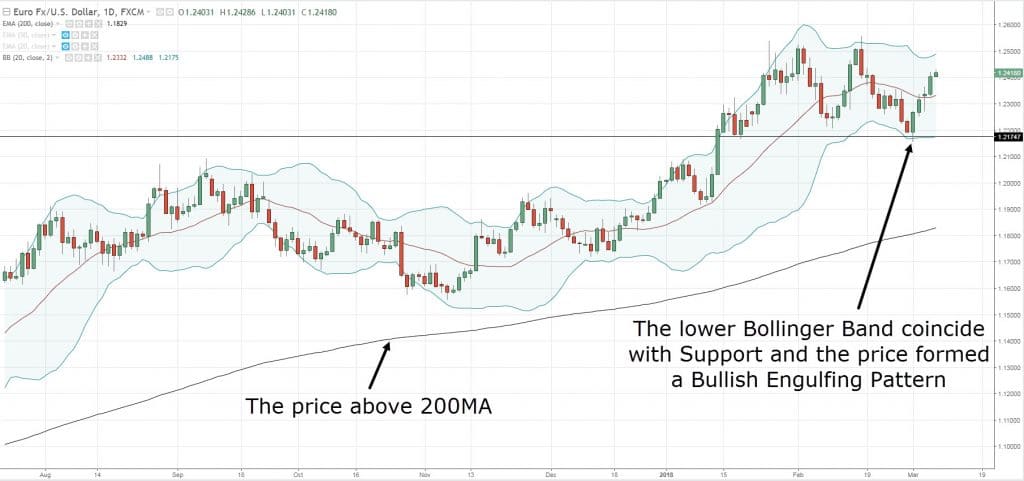
- The outer bands coincide with Back up and Resistance
Here'due south an example:
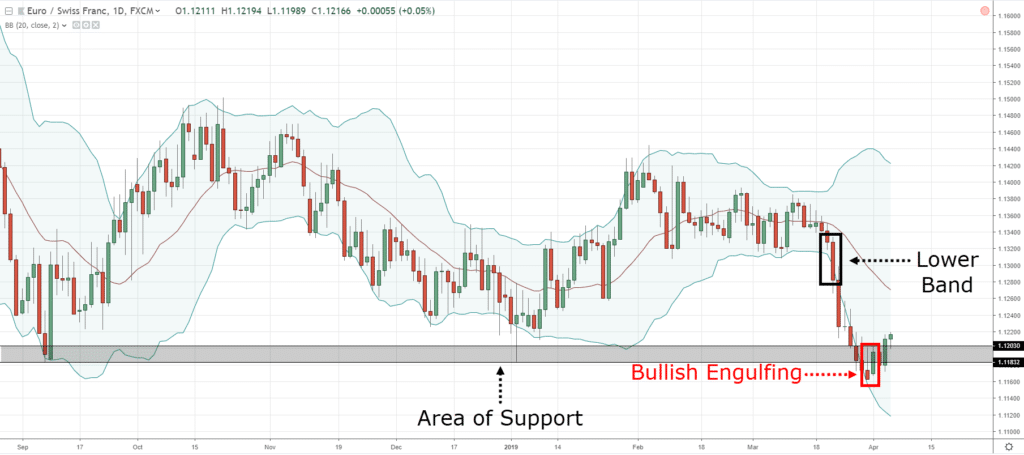
The price on EUR/USD is at the lower Bollinger Band that coincides with Support, and it formed Bullish Engulfing blueprint.
Pro Tip: You tin arrange your Bollinger Bands settings to 3 standard deviation (or higher) to identify fifty-fifty more overbought/oversold levels to trade off.
Moving on…
Bollinger Bands Squeeze: How to place explosive breakout trades about to occur
Hither's a fact:
Volatility is always changing.
The markets motion from a menstruation of high volatility to low volatility (and vice versa).
If you're a new trader, it can exist difficult to identify the volatility of the markets.
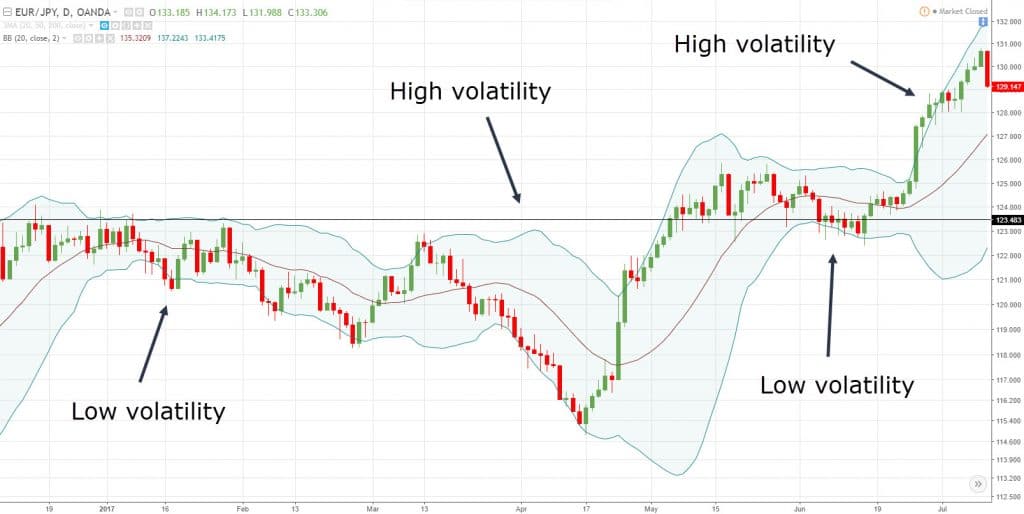
So, this is where Bollinger Bands can help because it contracts when volatility is low and expands when volatility is high.
Here'southward an example:
So, the question is…
How do you use Bollinger Bands to anticipate a possible breakout?
Unproblematic.
You look for the Bollinger Bands to contract (or clasp) because it tells you the marketplace is in a low volatility environment.
Why?
Considering volatility tends to expand afterwards wrinkle!
An instance: Before the breakdown, Rough Oil is in a depression volatility environment (equally shown by the contraction of the bands).
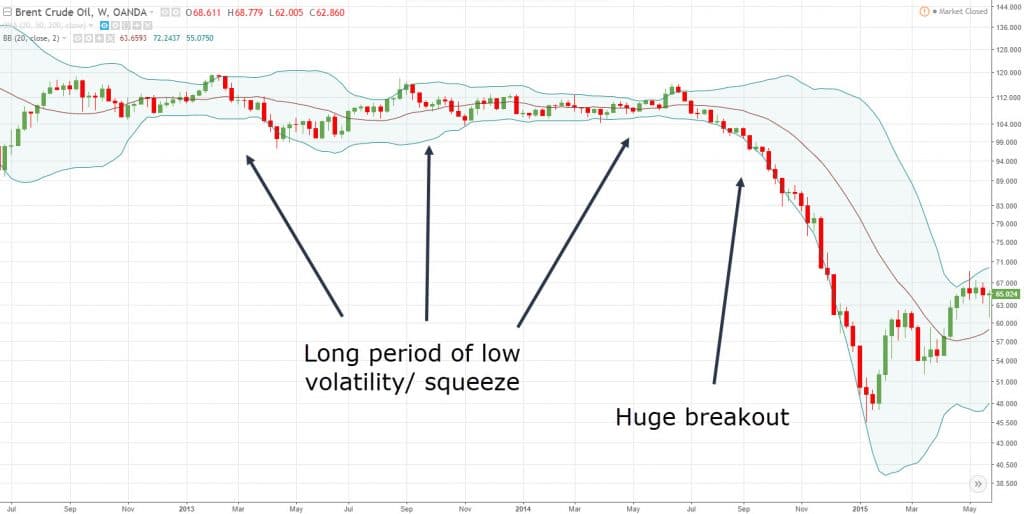
Pro Tip: The longer the volatility wrinkle, the stronger the subsequent breakout volition be.
How to identify the direction of the breakout
Now…
Although Bollinger Bands tin can alert you to potential breakout trades, information technology doesn't tell you the direction of the breakout.
Withal, y'all don't demand to be Einstein to figure out where the market is probable to go.
Because all you need to do is look at the trend.
Expect at the chart below:
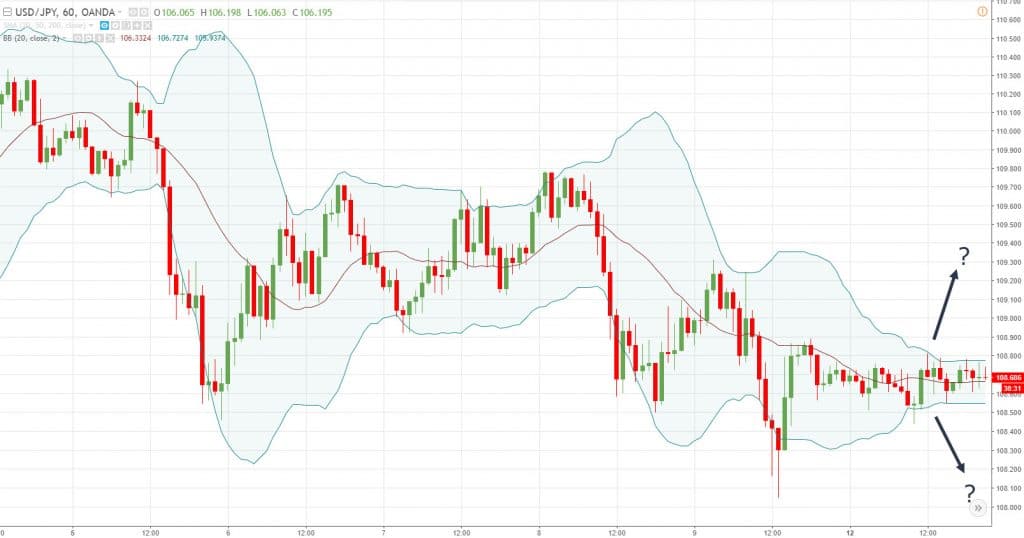
Where practise y'all remember the market is probable to breakout, higher or lower?
Probably lower because the tendency is downwards.
And you're correct because the market broke down lower (yes I cherry-picked this chart)…
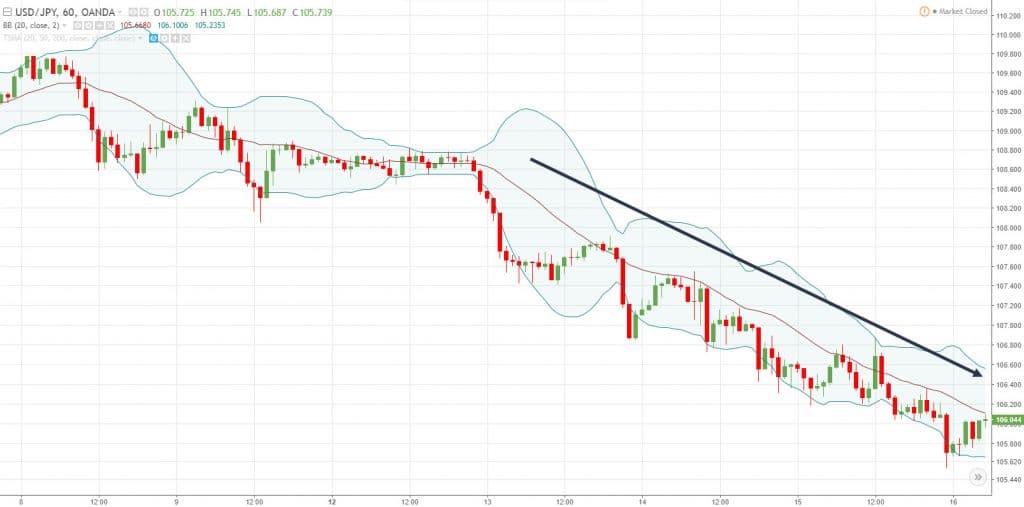
Simple all the same powerful, right?
How to merchandise with the trend using Bollinger bands
Here'south the deal:
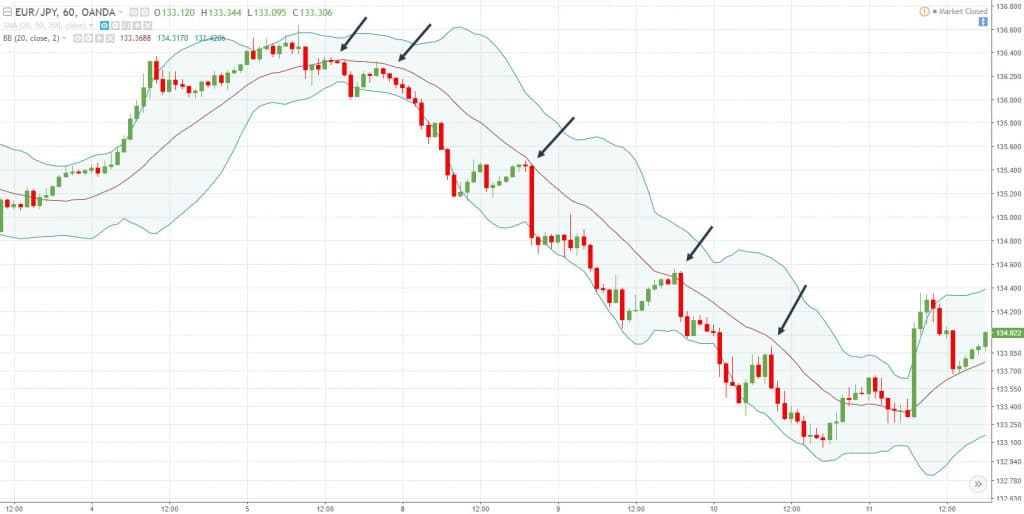
You know the middle line of the Bollinger Bands is just a 20-flow moving average (otherwise known as the mean of the Bollinger Bands).
And in stiff trending markets, the 20-period moving average can deed as an "expanse of value".
This ways when the marketplace pullback towards the xx MA, it's an opportunity for you to go long (or brusk).
An case: The cost bouncing off the 20-period moving boilerplate and it offers shorting opportunities…
Here's another example:
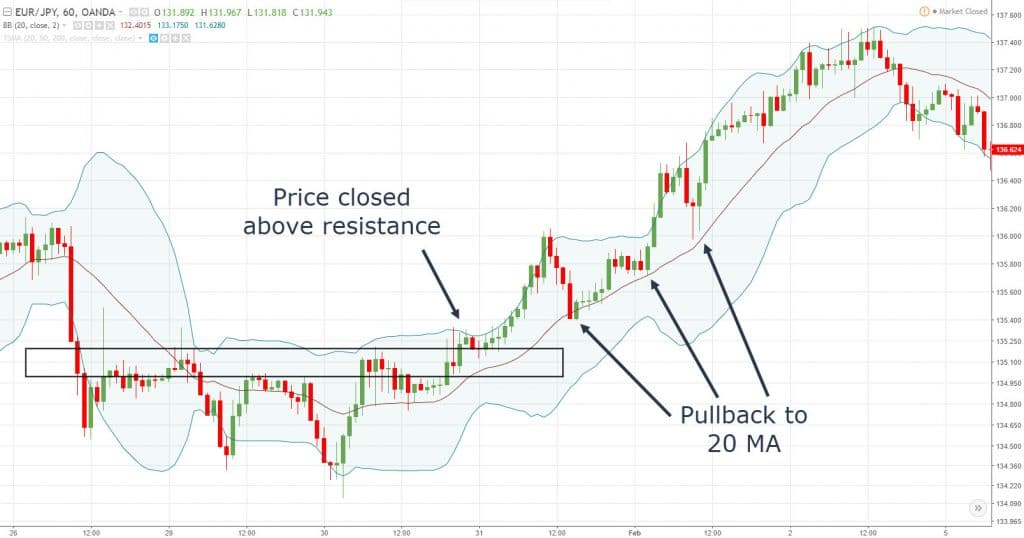
Pro Tip: If y'all desire to ride the trend, you tin trail your stop-loss using the 20 MA, or the outer Bollinger Bands.
The Bollinger Bands and RSI Philharmonic (a little-known technique)
Here's the thing:
The Bollinger Bands indicator is great for identifying areas of value on your chart.
But the trouble is… it doesn't tell you the strength or weakness behind the move.
For case: How practise yous tell if the market place will proceed to trade outside of the outer bands or mean revert?
That's where the Relative Force Index (RSI) indicator comes into play.
And what you're looking for is a deviation on the RSI indicator.
You're probably wondering:
"What is an RSI divergence?"
Well, it tin go 2 means…
- A bearish divergence is when the market makes a higher high, simply the RSI indicator shows a lower loftier (a sign of weakness)
- A bullish divergence ways is when the market place makes a lower low, simply the RSI indicator shows a higher depression (a sign of strength)
So, now the question is…
"How do you combine RSI divergence with Bollinger Bands?"
Here'southward how:
If the price is at upper Bollinger Bands, and so you tin can await for a bearish RSI divergence to bespeak weakness in the underlying movement.
Or…
If the toll is at lower Bollinger Bands, so you can wait for bullish RSI difference to indicate strength in the underlying move.
Here's an example:
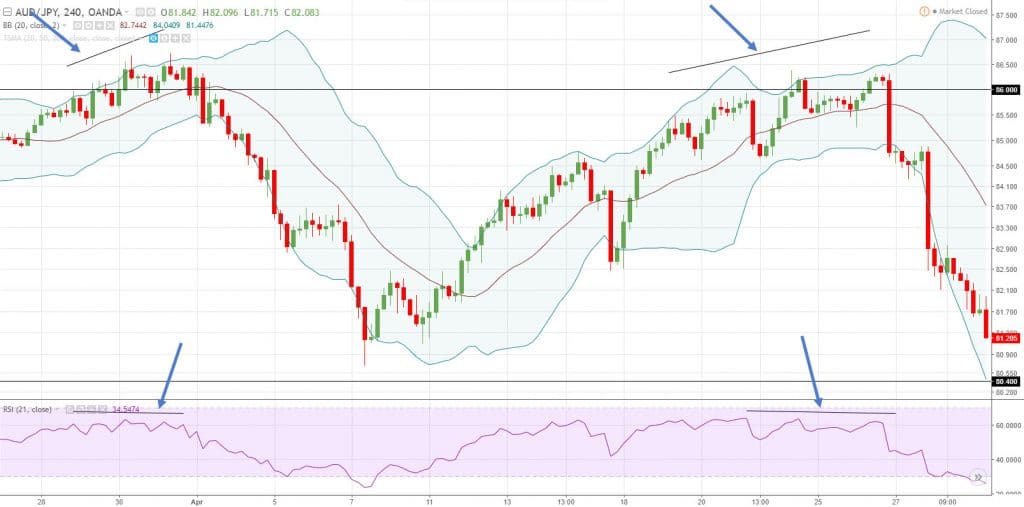
Pro Tip: You tin can combine this technique with Support and Resistance to detect high probability reversal trades.
The Rubber Ring outcome: How to use Bollinger Bands and "predict" market reversal
At present:
You can remember of Bollinger Bands similar a rubber band.
Whenever the price gets too far away from information technology, it tends to mean revert back towards the middle band.
You're probably thinking…
"Just how do you know when information technology'south about to snap dorsum? Because the price can stay overstretched for a long time."
You're absolutely right.
That's why you must as well take into consideration Bollinger Bands, Support Resistance, and Candlestick patterns.
Here's how information technology works…
(For long setups)
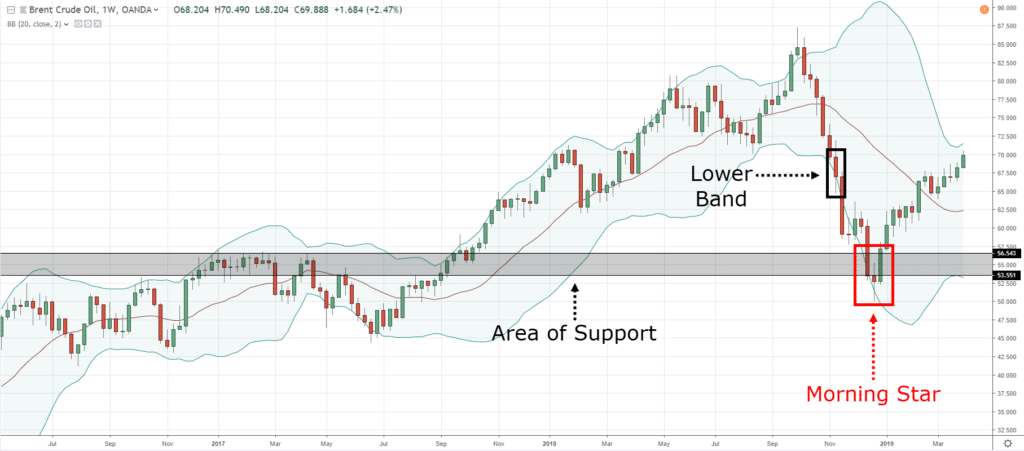
- Look for stiff momentum into Support
- Y'all desire to see the candle shut outside the lower Bollinger Bands (this tells yous the market place is overstretched)
- If the next candle is a bullish reversal pattern (like Hammer, Bullish Engulfing, etc.), then the marketplace is likely to reverse higher
- And vice versa for short setups
Here's what I mean…
Cost bounced from Support at EUR/CHF Daily:
Toll bounced from Support at Brent Crude Oil Weekly:
Pro Tip:
By default, the outer bands are 2 standard deviations abroad from the middle band (20MA).
If you want to identify even more overstretch market place conditions, you can increase the standard deviation to 3 or more.
Often asked questions
#1: Hey Rayner, what timeframe does the Bollinger Bands work best on?
There's really no best timeframe out there to use the Bollinger Bands as the concepts I've shared tin be practical across dissimilar timeframes.
And so it depends on your trading way and approach:
- If you're a day trader, then you'll utilise the Bollinger Bands on the lower timeframe like the fifteen-minutes or v-minutes timeframe.
- If yous're a swing or position trader, and so y'all'll use the Bollinger Bands on the daily or the weekly timeframe.
#two: Is at that place any difference between the accumulation stage of a market and a Bollinger Bands clasp?
Yes, in that location are differences. An accumulation stage is a range market within a downtrend, where you can identify resistance and support equally price swings upwardly and down within the accumulation.
Whereas in a Bollinger Bands clasp, the market doesn't swing upwards and down considering the toll action gets really tight and the candles are overlapping one another. So it'south impossible to place support and resistance in a Bollinger Bands clasp.
#three: Is it ameliorate to apply Bollinger Bands to trade breakout or to trade market reversals?
It can similarly serve for both breakout and reversal trades.
Y'all tin can look to merchandise breakouts afterwards a Bollinger Bands squeeze.
Or you lot can likewise use it to merchandise market reversals after the Bollinger Bands expand, which shows the increase in volatility of the market place. If the price comes to a central market structure like support resistance and then forms a price rejection, that's a possible opportunity for you to take a reversal merchandise.
Conclusion
Here'south what you've learned today:
- The Bollinger Bands indicator can aid y'all identify when the marketplace is "cheap" or "expensive"
- In an uptrend, you tin long virtually the lower Bollinger Band
- In a downtrend, you tin curt near the upper Bollinger Band
- When the Bollinger Bands is in a clasp, it signals the market is "fix" to breakout
- You tin can use the 20-period moving boilerplate to time your entries in trending marketplace
- Y'all can utilise Bollinger Bands and RSI divergence to find high probability reversal trades
- You lot can use Bollinger Bands and Back up and Resistance to "predict" market reversal
Now, here's what I would similar to know…
How do you employ the Bollinger Bands trading indicator?
Allow me know your thoughts in the comments department below.

Source: https://www.tradingwithrayner.com/bollinger-bands-trading-strategy/
Posted by: rossfunition.blogspot.com
0 Response to "using macd and bollinger bands for binary options hourly trade"
Post a Comment